How Loud Should Music Be in a Fitness Class?
Loud music feels like energy. But past a point it costs your members their hearing and costs you your voice, and it doesn't make anyone work harder. Here's where that point is.
The short answer
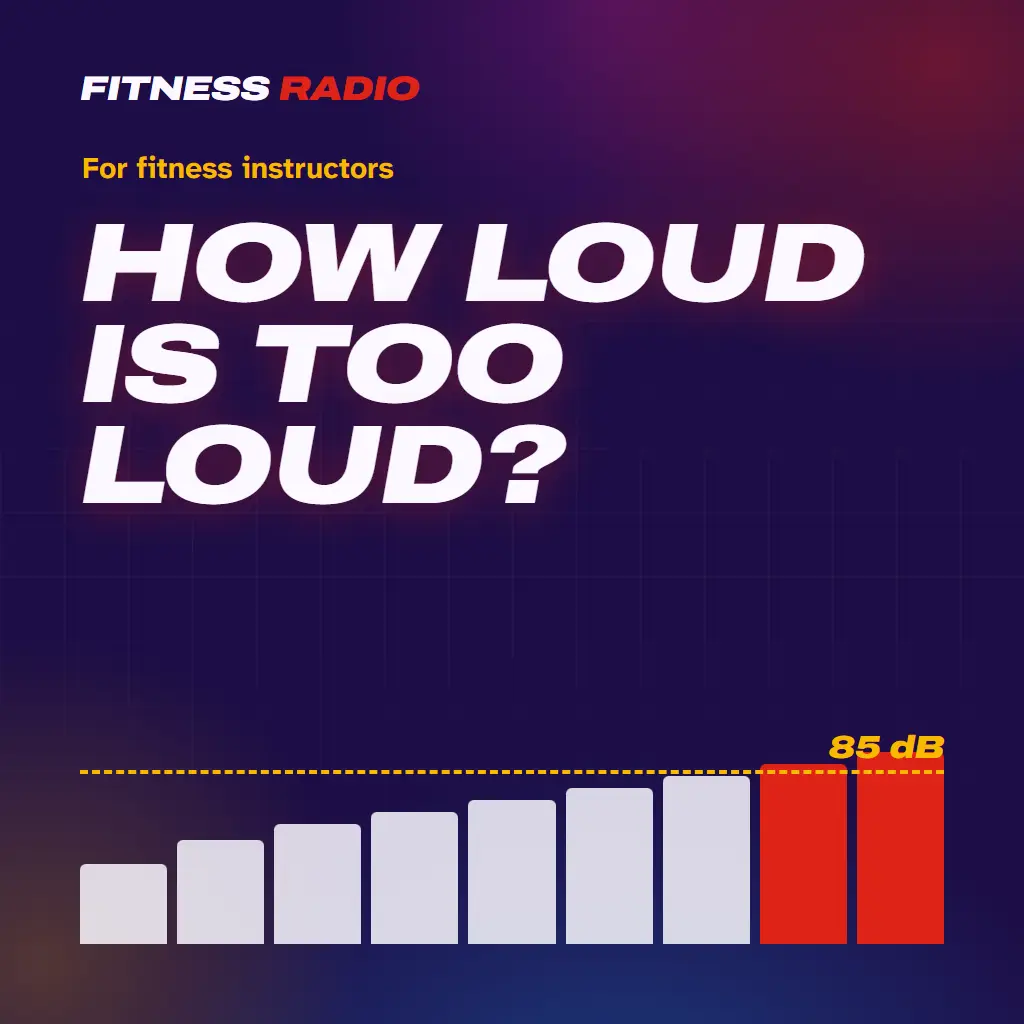
Keep class music at or under 85 decibels. That's the guideline from both the American Council on Exercise and IDEA Health & Fitness Association. IDEA adds that your voice needs to be about 10 decibels louder than the music to be heard, so it should top out around 95 decibels, and for no more than an hour at that level (IDEA, Recommendations for Music Volume in Fitness Settings).
How long is safe at each level
The risk depends on how loud and for how long. The US National Institute for Occupational Safety and Health (NIOSH) sets its recommended limit at 85 decibels averaged over eight hours, and every 3 decibels louder halves the safe time:
| Sound level | Recommended daily limit |
|---|---|
| 85 dB | 8 hours |
| 88 dB | 4 hours |
| 91 dB | 2 hours |
| 94 dB | 1 hour |
| 97 dB | 30 minutes |
| 100 dB | 15 minutes |
A single hour-long class at 94 decibels uses up a full day's allowance. If you teach two or three classes a day, the exposure adds up for you much faster than for anyone in the room.
Louder doesn't mean harder
In 2021, researchers at the University of Maryland School of Medicine measured indoor cycling classes playing at 93 to 101 decibels. Riders in classes 2 to 3 decibels quieter than the loudest didn't work any less hard. More than one in four riders reported ringing or muffled hearing after class, and riders were most likely to call the volume right in the quietest classes (University of Maryland School of Medicine, 2021).
IDEA puts it simply: motivate with creativity and enthusiasm, not volume.
How to check your room
- Measure it. A sound level meter reads the level at a moment. Free sound meter apps for phones give a useful first reading.
- Measure where people stand. Check from the middle of the room and the spots nearest the speakers, not from the instructor platform.
- Measure the loudest song. The peak of class is what counts, not the warm-up.
- Mark the dial. Once you find the setting that reads 85, put a piece of tape there so every instructor can find it.
Turn it down without losing the energy
- Use a microphone. It lets you sit well above the music without straining. Your voice will thank you by the end of the week.
- Adjust the tone, not just the volume. ACE passes on audiologists' advice to turn up the bass and lower the treble if you need to adjust the sound.
- Let the music do the work. A strong, clear beat carries a room at a sensible volume. A muddy track has to be loud to be felt.
- Cue with your body. Point, count with your fingers, and let the countdown show before you say it. More on that in When to Cue.
Music that works at a sensible volume
Phrased workout tracks start every phrase on a strong downbeat, so your class can follow the count without the music blasting. On Fitness Radio, phrased tracks end on a 32 and play gapless, so there's no silence to fill with a louder next song.