How to Build Choreography in 32-Count Blocks
Good choreography feels effortless to follow. Behind that is a simple structure: blocks of 32 counts that match the phrases in the music. Here's how to build one, teach it and keep it fresh.
A block is four eight-counts
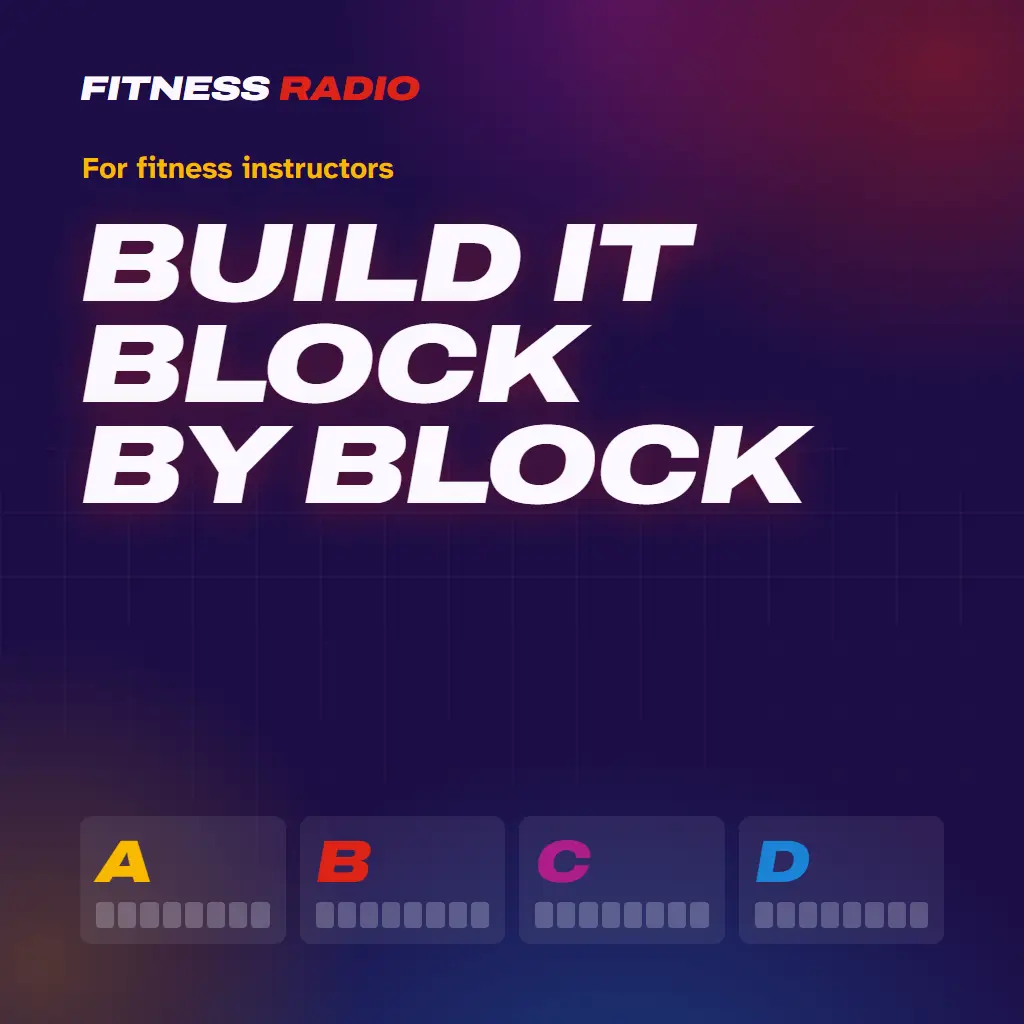
A 32-count block is four eight-counts, which the American Council on Exercise's handbook suggests labeling A, B, C and D when you plan a class (ACE, Group Fitness Instructor Handbook, chapter preview). Here's a simple low-impact block:
| Eight-count | Move | Counts |
|---|---|---|
| A | Two V-steps | 1 to 8 |
| B | Grapevine right, grapevine left | 9 to 16 |
| C | Four alternating knee lifts | 17 to 24 |
| D | Four step touches | 25 to 32 |
When the block starts on the top of a phrase, the music turns over just as the block repeats. If phrases are new to you, start with What Is 32-Count Music?
Rules of thumb for a block
- Make it repeatable. The last move should hand off cleanly to the first, so the block can loop without a stumble.
- Check the lead foot. If a block starts on the right and ends on the right, it repeats on the right forever. Either balance it or plan the switch.
- Mix travel and in-place moves. A block that travels and comes back keeps the room from drifting.
- Start simple. You can always layer complexity on a block the class already knows. It's much harder to strip it back.
Five ways to teach it
ACE describes five common strategies for teaching beat-based choreography. Each one gets people to the full combination without losing them on the way.
- Slow to fast. Teach the move at half or quarter time first, then bring it up to full tempo once the form is there.
- Part to whole. Teach each piece on its own, then put them together. Legs first, then arms, then both.
- Repetition reduction. Do each move many times, then halve the reps until they become the combination. See the example below.
- Simple to complex. Also called layering. Everyone starts with a base pattern, and you add options: a direction change, a turn, a longer lever.
- Linear progression. The freestyle approach: change one thing at a time and let one move flow into the next, without a repeating pattern.
Here's repetition reduction for hamstring curls and knee lifts, two counts each. Every phrase is exactly 32 counts, so each step lines up with the music:
| Phrase | What the class does |
|---|---|
| 1 | 8 hamstring curls, then 8 knee lifts |
| 2 | 4 curls, 4 knee lifts, twice |
| 3 | 2 curls, 2 knee lifts, four times |
| 4 | 1 curl, 1 knee lift, eight times |
Change it without starting over
A block can feel new without new moves. Change one element at a time:
- Lever length. A hamstring curl becomes a straight-leg kick back.
- Direction. Side-to-side moves turn front-to-back, or travel on a diagonal.
- Plane. A front lunge becomes a side lunge.
- Rhythm. Take a move to half time, or double it up.
- Intensity. A march becomes a jog, or a jog becomes a jump.
- Style. The same pattern with an athletic, dance or martial-arts feel.
Cue it at the end of the phrase
Your cue for the next block belongs in the last eight counts of the one before it, the D of your A to D. Our post on when to cue walks through the counts.
Let the music hold the structure
Blocks only work when the phrases in the music stay whole. Phrased tracks start on their first downbeat and end on a 32, so the top of every phrase is where your block expects it. On Fitness Radio, gapless playback carries the count through track changes, and on the instructor and gym plans, BPM control lets you teach a new block slower, then bring the same song back up to speed. Our step aerobics music guide has the safe tempo for each step level.