Workout Music BPM Chart: The Tempo for Every Class Format
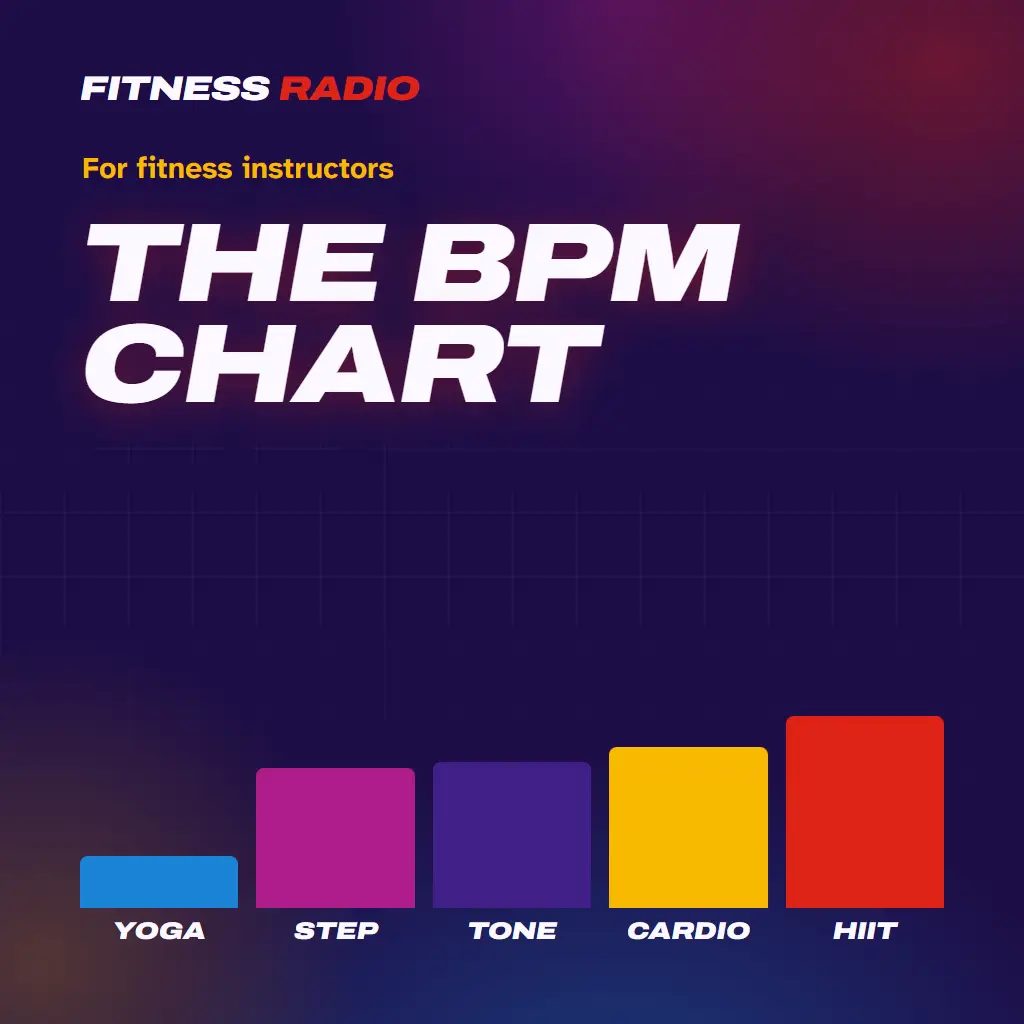
Every class format has a tempo where it feels right. This chart collects them in one place, with the source for each, so you can plan faster and teach safer. Treat each range as a starting point: your room, your moves and your members have the final say.
The chart
| Format | Tempo | Notes |
|---|---|---|
| Yoga, Pilates and stretching | Under 100 BPM | Music mostly in the background (ACE) |
| Beginner step, low-impact aerobics and hip-hop | 100 to 122 BPM | The low end of ACE's ranges |
| Step, by level | 118 to 128 BPM | Novice 118 to 122, beginner 124, intermediate 126, advanced 128, and never above 128 (ACE) |
| Toning, conditioning and low-to-mid impact | 122 to 129 BPM | Includes some dance and aquatic classes (ACE) |
| High-energy group fitness | 128 to 132 BPM | The sweet spot in our 128 to 132 BPM guide |
| Fitness Radio users' default | 136 BPM | The tempo most users set, and every Daily Mix |
| Mid-to-high impact, kickboxing and faster dance | 130 to 160 BPM | The top of ACE's ranges |
| Indoor cycling flats | 80 to 110 BPM | One foot on each beat, so BPM equals RPM |
| Indoor cycling climbs | 120 to 160 BPM | Both feet on the beat, so RPM is half the BPM |
| Tabata, 20 on and 10 off | 144 BPM | Six eight-counts on, three off, every round |
| HIIT, 30/30, 45/15 and 30/15 | 128 BPM | Every interval lands on a whole phrase |
| Running | Your steps per minute, or half | Match the beat to your stride |
The general ranges come from the American Council on Exercise's tempo table for group fitness (ACE, 4 Factors to Help You Understand and Master Music Selection) and its step training guidelines (ACE, Step Training Guidelines). The cycling, HIIT and running rows are worked out in our class guides, below.
The guides behind the chart
Each class guide explains its row in full, with the math:
- Step aerobics music. Tempo and platform height by level, and how long a 32-count block takes at each tempo.
- Spin class music. How to match the beat to cadence, with an example 45-minute ride.
- HIIT and Tabata music. The tempos where common intervals land on the count.
- Running music. Matching BPM to your steps, and quickening your cadence a little at a time.
- Gym floor music. No set tempo: the floor needs music that runs all day.
How to use a BPM chart
- Plan the shape, not just the peak. Most classes build to their main tempo and come back down. See Warm-Up to Cool-Down.
- Fit the move, not just the format. A slow strength move can sit at half time inside a fast class. See Do You Have to Teach on the Beat?
- Respect the ceilings. Step's 128 BPM limit is about safety, not taste.
Set any song to the chart
You don't need a different library for every row. On the instructor and gym plans, Fitness Radio's BPM control time-stretches any track to the tempo you choose, from 60 to 200 BPM, without the chipmunk effect. More on that in Can You Change a Song's Tempo Without the Chipmunk Effect?